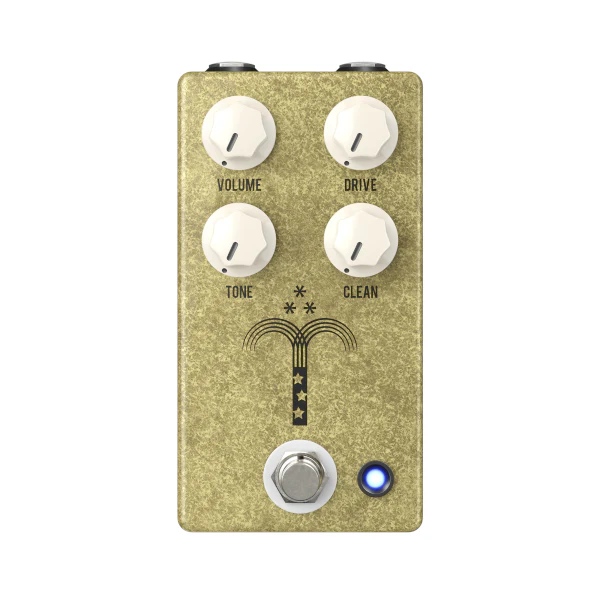
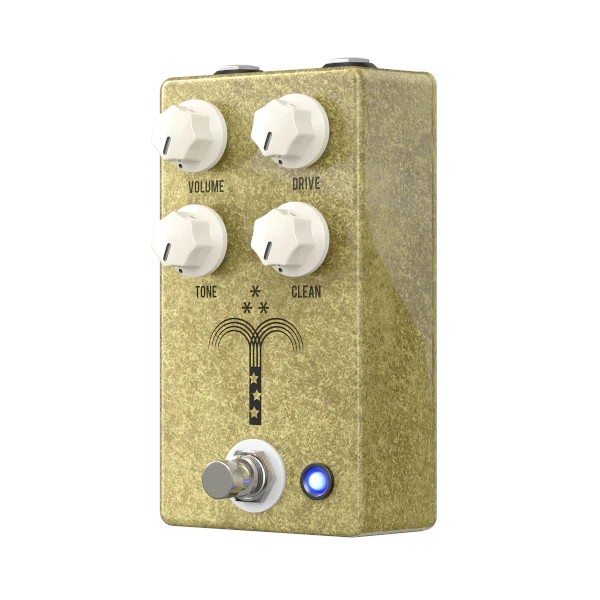
JHS Morning Glory Clean
When Transparent Overdrive Isn’t Good Enough
JHS took its most legendary overdrive to a new level and redefined what it means to be transparent. Clearer pick attack, improved low end, and more versatile gain stacking.
This is the ultimate first-stage overdrive pedal.
It Started at Soundcheck
JHS founder Josh Scott watched Julian Lage dial in his tone during a soundcheck in Chicago. Vintage Fender amp. Collings semi-hollow guitar. Julian adjusted pickup heights, moved positions on stage, chasing the perfect balance. It was captivating.
Julian has used a Morning Glory for years — he’s a big reason it ended up on jazz pedalboards worldwide. After the soundcheck, they discussed what he looked for in an overdrive. One thing led to another. Ideas started forming. Could the Morning Glory be made even better?
The Problem with Transparent
When you add overdrive — any type of clipping — you lose nuance. Pick attack gets compressed. Dynamics narrow. All overdrives shape frequency response, even the most transparent.
So JHS tried something no one else had done: they took the Morning Glory (a Bluesbreaker-style topology) and completely rebuilt it around a studio-grade parallel clean blend. Not a modification — a redesign from the ground up.
On paper, it seemed pointless. Why blend a clean signal into something already transparent?
Here’s why. The Morning Glory’s magic happens when the Drive is turned up. The circuit boosts higher harmonics and adds soft compression. Jangly. Perfect in a mix. The parallel clean circuit lets players keep all of that while dialing the natural low end back in — all the tone, all the character. Nothing compromised.
This Isn’t a Clean Knob Slapped on a Morning Glory
For those wondering what’s actually happening inside:
The Clean control uses a dual-gang potentiometer. As it’s turned, clean gain scales proportionally with the drive signal — engineered from the ground up. Most clean blends are an afterthought, a simple mix knob tacked onto an existing circuit. This one was designed so the two signals track together across all gain settings.
No volume jumps.
No weird phase issues.
Just seamless blending from Morning Glory to pure signal and everything in between.
The power section runs on a ±9V dual supply — the same topology used in JHS’s V4 — giving higher headroom than the original V1 circuit and any other Bluesbreaker-style pedal available. This is where most clones get it wrong.
Think of it as the original Version 1 Morning Glory voicing with V4 engineering enhancements.
The Tone control affects only the overdrive path. The clean signal stays parallel and untouched.
For the people who care about this stuff: this is the most thought-out and sophisticated Morning Glory JHS has ever built.
Endless Headroom. Any Volume.
Those massive clean guitar sounds heard on recordings were often made at volumes that would get most players evicted. The Morning Glory Clean delivers the stiffness and authority of a high-wattage amp at the edge of breakup — without the earplugs.
Think of the Clean control as adding back wattage, clarity, and punch.
It Goes on Everything
Stack a distortion in front and sustain opens up instead of closing off. Run it after delay for new series/parallel textures. As a first-stage overdrive, this is the best JHS has ever built. Period.
It breathes in front of amp modelers too — delivering the overdrive and presence of the classic Morning Glory while dialing attack and low-end content back in. Magic in front of a Kemper, Quad Cortex, UAD, or Helix.
Bass players take note: the original Morning Glory rolls off low end like a final mix. That’s why it became a standard on so many professional bass boards. The clean blend now lets players dial that low end back in on command for different bass and amplifier needs.
This may be the best bass overdrive JHS has ever made.
Who This Isn’t For
This pedal isn’t for everyone — and JHS is confident in saying that.
If you want the dopamine hit of a wild new sound, look elsewhere.
If you want tons of controls, tweakability, bells, and whistles — this isn’t it.
This pedal does less while giving you more. No bad sounds. Immediate gratification. Leave it on and forget it’s there.
Controls
Volume — Adjusts the overall volume in conjunction with the drive and clean.
Clean — Full left: original Morning Glory. Full right: pure clean signal. Start with Clean and Drive maxed, dial Clean back (counter clockwise) until you find your perfect balance.
Drive — Saturation. Crank it and use the Clean control as your balance. This pedal is designed to be used this way.
Tone — Classic Morning Glory tone stack. Affects only the drive path. Back for warmth, forward for clarity.
Key Features:
- Redesigned Morning Glory circuit with studio-grade parallel clean blend
- Clearer pick attack with improved low-end retention
- Dual-gang Clean control that scales clean gain proportionally with drive
- Seamless blending with no volume jumps or phase issues
- ±9V dual-supply power section for increased headroom
- Original Morning Glory V1 voicing with V4 engineering enhancements
- Tone control affects only the overdrive path; clean signal remains untouched
- High headroom feel of a high-wattage amp at the edge of breakup
- Optimised as an ultimate first-stage overdrive
- Excellent gain stacking without loss of dynamics
- Performs equally well with traditional amps and amp modelers
- Enhanced low-end control makes it suitable for both guitar and bass
Original: $216.16
-65%$216.16
$75.66Product Information
Product Information
Shipping & Returns
Shipping & Returns
Description
When Transparent Overdrive Isn’t Good Enough
JHS took its most legendary overdrive to a new level and redefined what it means to be transparent. Clearer pick attack, improved low end, and more versatile gain stacking.
This is the ultimate first-stage overdrive pedal.
It Started at Soundcheck
JHS founder Josh Scott watched Julian Lage dial in his tone during a soundcheck in Chicago. Vintage Fender amp. Collings semi-hollow guitar. Julian adjusted pickup heights, moved positions on stage, chasing the perfect balance. It was captivating.
Julian has used a Morning Glory for years — he’s a big reason it ended up on jazz pedalboards worldwide. After the soundcheck, they discussed what he looked for in an overdrive. One thing led to another. Ideas started forming. Could the Morning Glory be made even better?
The Problem with Transparent
When you add overdrive — any type of clipping — you lose nuance. Pick attack gets compressed. Dynamics narrow. All overdrives shape frequency response, even the most transparent.
So JHS tried something no one else had done: they took the Morning Glory (a Bluesbreaker-style topology) and completely rebuilt it around a studio-grade parallel clean blend. Not a modification — a redesign from the ground up.
On paper, it seemed pointless. Why blend a clean signal into something already transparent?
Here’s why. The Morning Glory’s magic happens when the Drive is turned up. The circuit boosts higher harmonics and adds soft compression. Jangly. Perfect in a mix. The parallel clean circuit lets players keep all of that while dialing the natural low end back in — all the tone, all the character. Nothing compromised.
This Isn’t a Clean Knob Slapped on a Morning Glory
For those wondering what’s actually happening inside:
The Clean control uses a dual-gang potentiometer. As it’s turned, clean gain scales proportionally with the drive signal — engineered from the ground up. Most clean blends are an afterthought, a simple mix knob tacked onto an existing circuit. This one was designed so the two signals track together across all gain settings.
No volume jumps.
No weird phase issues.
Just seamless blending from Morning Glory to pure signal and everything in between.
The power section runs on a ±9V dual supply — the same topology used in JHS’s V4 — giving higher headroom than the original V1 circuit and any other Bluesbreaker-style pedal available. This is where most clones get it wrong.
Think of it as the original Version 1 Morning Glory voicing with V4 engineering enhancements.
The Tone control affects only the overdrive path. The clean signal stays parallel and untouched.
For the people who care about this stuff: this is the most thought-out and sophisticated Morning Glory JHS has ever built.
Endless Headroom. Any Volume.
Those massive clean guitar sounds heard on recordings were often made at volumes that would get most players evicted. The Morning Glory Clean delivers the stiffness and authority of a high-wattage amp at the edge of breakup — without the earplugs.
Think of the Clean control as adding back wattage, clarity, and punch.
It Goes on Everything
Stack a distortion in front and sustain opens up instead of closing off. Run it after delay for new series/parallel textures. As a first-stage overdrive, this is the best JHS has ever built. Period.
It breathes in front of amp modelers too — delivering the overdrive and presence of the classic Morning Glory while dialing attack and low-end content back in. Magic in front of a Kemper, Quad Cortex, UAD, or Helix.
Bass players take note: the original Morning Glory rolls off low end like a final mix. That’s why it became a standard on so many professional bass boards. The clean blend now lets players dial that low end back in on command for different bass and amplifier needs.
This may be the best bass overdrive JHS has ever made.
Who This Isn’t For
This pedal isn’t for everyone — and JHS is confident in saying that.
If you want the dopamine hit of a wild new sound, look elsewhere.
If you want tons of controls, tweakability, bells, and whistles — this isn’t it.
This pedal does less while giving you more. No bad sounds. Immediate gratification. Leave it on and forget it’s there.
Controls
Volume — Adjusts the overall volume in conjunction with the drive and clean.
Clean — Full left: original Morning Glory. Full right: pure clean signal. Start with Clean and Drive maxed, dial Clean back (counter clockwise) until you find your perfect balance.
Drive — Saturation. Crank it and use the Clean control as your balance. This pedal is designed to be used this way.
Tone — Classic Morning Glory tone stack. Affects only the drive path. Back for warmth, forward for clarity.
Key Features:
- Redesigned Morning Glory circuit with studio-grade parallel clean blend
- Clearer pick attack with improved low-end retention
- Dual-gang Clean control that scales clean gain proportionally with drive
- Seamless blending with no volume jumps or phase issues
- ±9V dual-supply power section for increased headroom
- Original Morning Glory V1 voicing with V4 engineering enhancements
- Tone control affects only the overdrive path; clean signal remains untouched
- High headroom feel of a high-wattage amp at the edge of breakup
- Optimised as an ultimate first-stage overdrive
- Excellent gain stacking without loss of dynamics
- Performs equally well with traditional amps and amp modelers
- Enhanced low-end control makes it suitable for both guitar and bass